Background: Given a project.sqlite file which contains a table called 'startups‘ that consists of data from startup companies.
Data Source: “Learn SQL” course from Codecademy.
Objective: Write queries with aggregate functions to retrieve interesting insights about these companies.
Research & Tools: The dataset was examined with PostgreSQL for a comprehensive view and for exploring key trends. The SQLite code for this project can be found on my GitHub page. Tableau was used to create visual representations of significant trends and to provide insight into the data.
Detailed Analysis
Location Trends
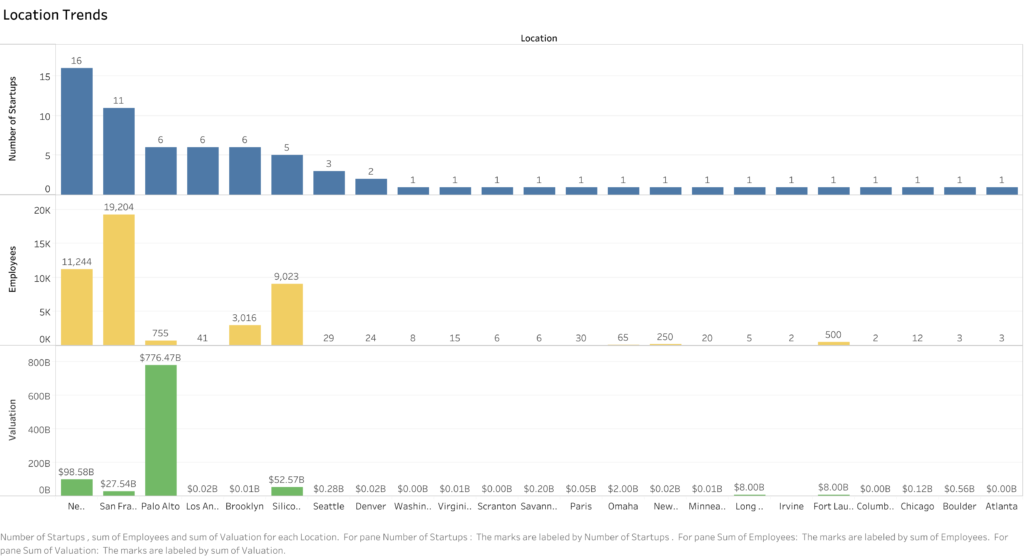
In analyzing location trends among startup companies, the goal was to identify cities with the highest concentration of startups. The findings revealed that New York topped the list as the city with the most startup activity, followed closely by San Francisco. Due to the high concentration of startups in New York and San Francisco, both of these markets are highly competitive in comparison to the other locations in the dataset. It’s noteworthy that while San Francisco didn’t have the highest number of startups, it did host the largest companies in the entire dataset, as evident from the total number of employees employed by San Francisco-based startups. This implies that San Francisco serves as a hub for startups that, while fewer in number, are significant in size and workforce.
Delving into the valuation of startup companies based on location, Palo Alto emerged as the city housing the highest-valued startups. Interestingly, this observation comes despite Palo Alto ranking third in startup activity and fourth in terms of company size among the cities considered. This trend suggests that Palo Alto is a preferred choice among startups that fall within the relatively small to medium-sized category (employing less than 1000 employees) yet exhibit remarkable valuations. The city’s ecosystem seems to foster the growth and success of these select companies, positioning it as a top destination for startups seeking both quality and valuation growth.
Category Analysis
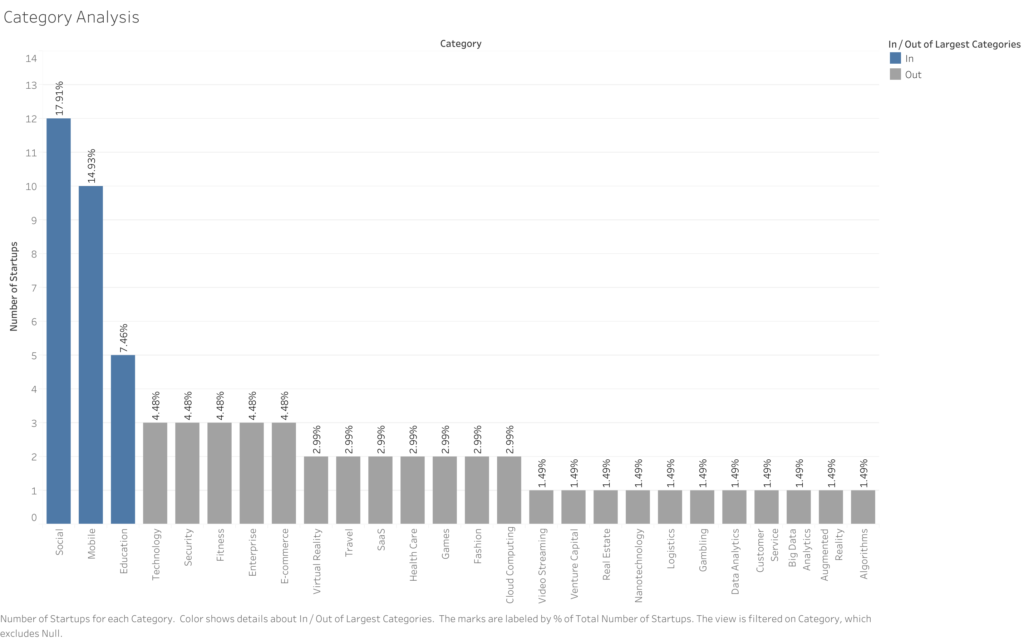
Analyzing the categorical types of startup companies, it’s evident that the majority belong to the social category, followed closely by mobile and education. These categories appear to be highly competitive due to their substantial representation, accounting for 40% of all startup companies in the dataset.
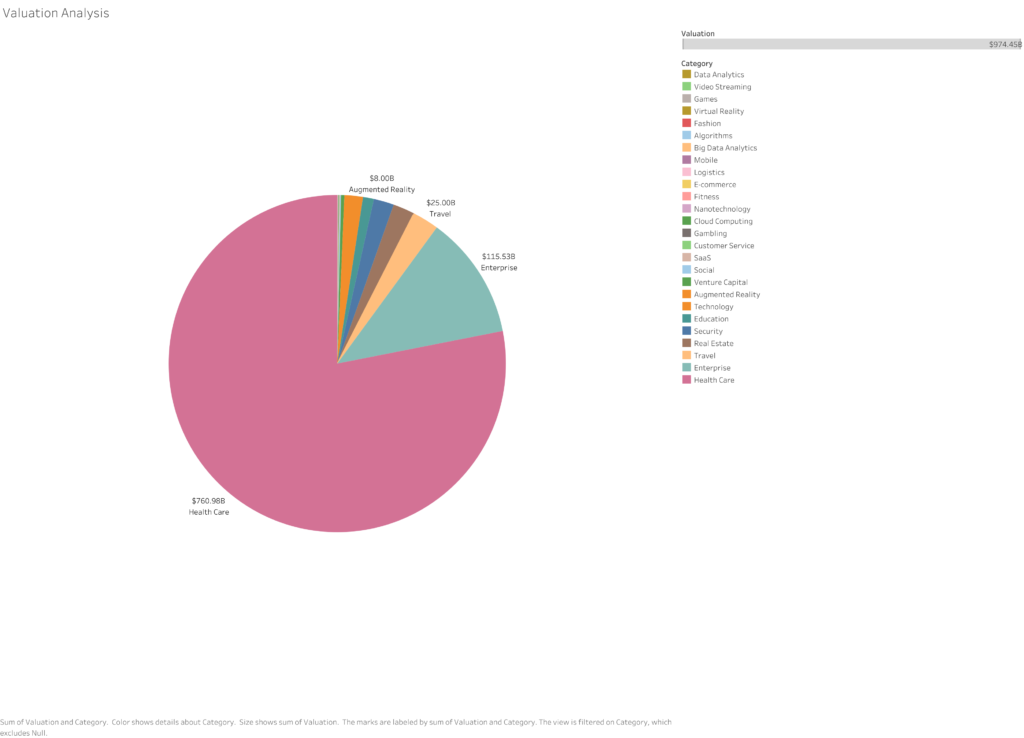
However, when we delve deeper into the data, a significant disparity emerges between categorical popularity and company valuation. Surprisingly, these three dominant categories—social, mobile, and education—contribute to less than 2% of the total valuation of all companies in the dataset.
A similar trend can be observed in the enterprise and travel categories, although it’s not as significant as the healthcare category. These categories, despite not being as popular as social, mobile, or education, also exhibit a disconnect between their representation and company valuation. In contrast, the healthcare category, with just two companies, commands a staggering 78% of the total valuation among the startups analyzed. This highlights the intriguing dynamics of the startup landscape, where popularity doesn’t necessarily translate to higher valuation.
Founding Year Analysis
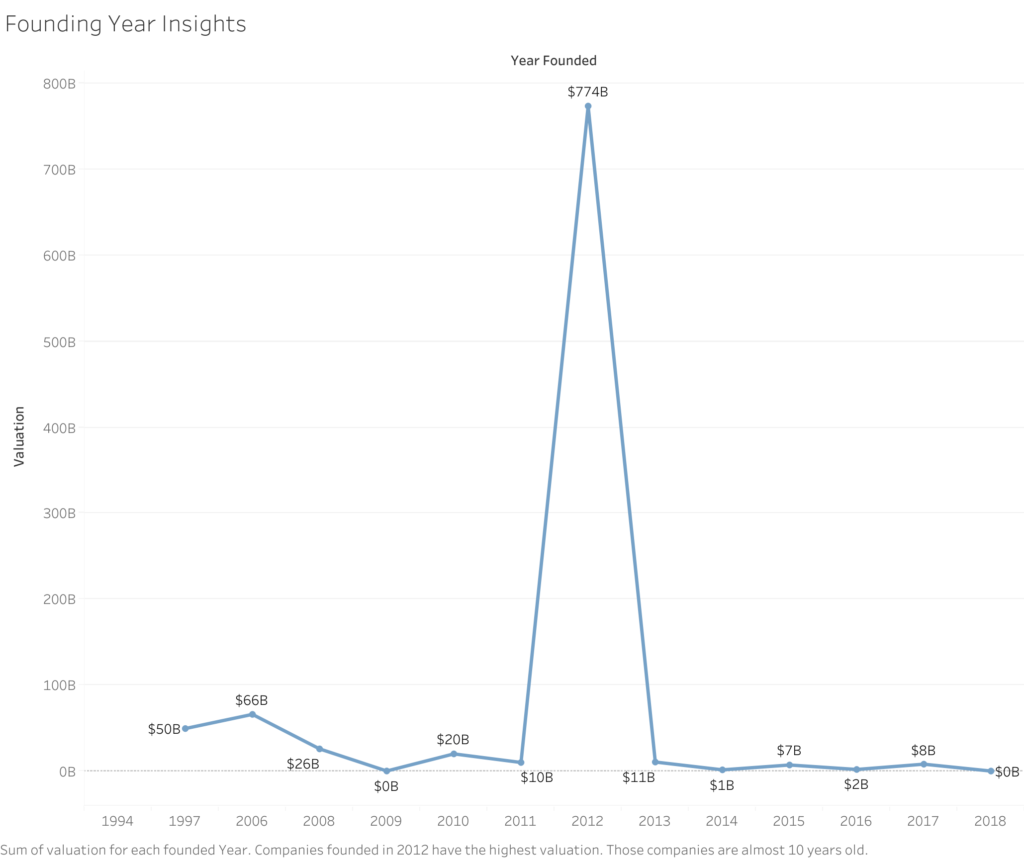
When examining the age of the startup companies in the dataset, it becomes clear that the companies with the highest valuation are approximately 10 years old. This insight aligns with the notion of “early mover advantage.” Startups founded in the early 2010s may have benefited from favorable market conditions and economic growth during that period, which contributed to their impressive valuations. For instance, there were a total of 11 companies founded in 2012, and their combined valuation is a staggering $774 billion. This underscores how market timing and innovation during the early stages of a startup’s existence can lead to significant valuation growth.
While other founding years may have had a similar number of companies, none of those years appear to have achieved a comparable valuation. This highlights the importance of considering not only the number of startups but also their strategic timing, disruptive potential, and ability to seize market opportunities when analyzing their eventual valuations.
Key Insights:
The dataset examined a total of 70 startup companies with a combined value of $974B. My analysis of startup trends across various dimensions has unveiled several key insights into the dynamic world of entrepreneurship.
Firstly, when it comes to location, New York and San Francisco emerge as bustling hubs of startup activity, showcasing the high level of competition in these markets. San Francisco, despite hosting fewer startups, stands out as the home to some of the most significant companies in the dataset, emphasizing its role as a hub for large, impactful startups.
Moving on to valuation, Palo Alto shines as the city housing the highest-valued startups, even though it ranks lower in startup activity and company size. This observation underscores how Palo Alto fosters the growth and success of medium-sized startups, making it an attractive destination for those seeking both quality and valuation growth.
Analysis of categorical trends revealed that while social, mobile, and education startups dominate in terms of quantity, they contribute minimally to the overall valuation of the dataset. A similar trend is observed in enterprise and travel categories, though not as pronounced as in healthcare. This disparity underscores the complex relationship between popularity and valuation in the startup landscape.
Lastly, the age of startups plays a crucial role in their valuation, highlighting the concept of “early mover advantage.” Companies founded during specific windows of opportunity, such as the early 2010s, tend to exhibit impressive valuations. This emphasizes the importance of timing, innovation, and strategic vision in determining a startup’s eventual success.
In essence, this analysis underscores the multifaceted nature of the startup ecosystem, where factors like location, category, and timing all interplay to shape a startup’s journey and ultimate valuation. Understanding these dynamics can offer valuable insights for aspiring entrepreneurs, investors, and those navigating the ever-evolving world of startups.